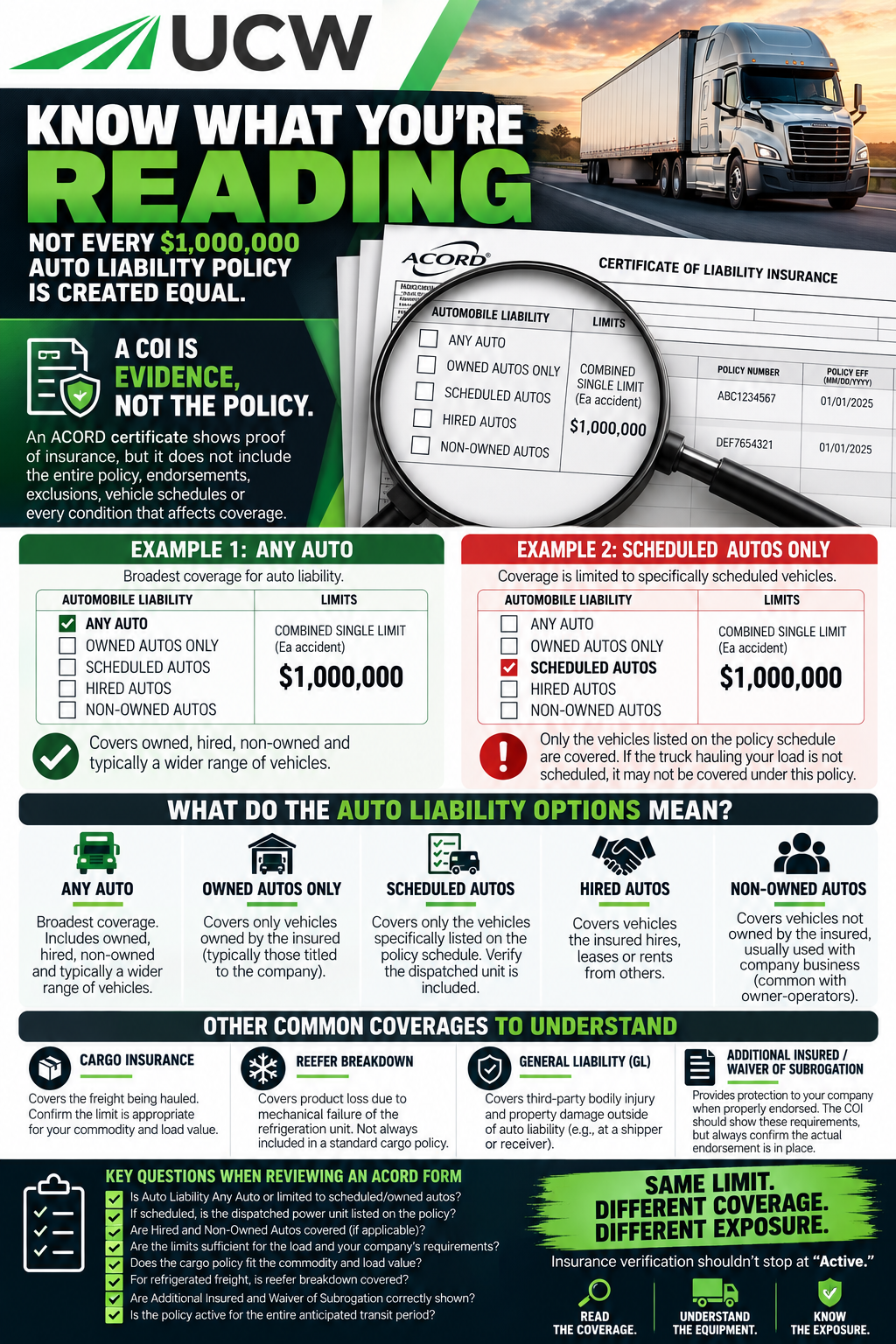
When reviewing carrier insurance, it’s easy to see a Certificate of Insurance (COI) showing $1,000,000 in auto liability coverage and assume the risk is covered. However, the reality is that two policies with the same coverage limit can provide very different levels of protection depending on how the policy is written.
A COI is proof that insurance exists, but it is not the actual policy. Important details such as endorsements, exclusions, covered vehicle classifications, and special conditions are contained within the policy itself. Those details can significantly impact whether a claim is covered when an accident occurs.
One of the most important areas to review is the type of auto liability coverage provided. Policies designated as “Any Auto” generally offer the broadest protection because they extend coverage across a wider range of vehicles, including owned, hired, and non-owned equipment. By comparison, policies written as “Scheduled Autos Only” limit coverage to vehicles specifically listed on the policy. If the vehicle involved in transporting a shipment is not included on that schedule, coverage may be limited or unavailable.
Shippers and logistics professionals should also evaluate other key coverages beyond auto liability, including cargo insurance, reefer breakdown protection, general liability coverage, and requirements such as additional insured endorsements and waiver of subrogation provisions. These components help paint a more complete picture of the carrier’s risk profile and overall protection.
At UCW Logistics, risk management is an important part of protecting our customers’ freight and supply chains. Insurance verification goes beyond confirming that a policy is active. We believe it is essential to understand the coverages, limitations, and potential exposures behind every certificate to make informed transportation decisions.
The next time you review a Certificate of Insurance (COI), remember: the limit may be the same, but the coverage may not be. Understanding the policy details can make all the difference when a claim occurs.
Same Limit. Different Coverage. Different Exposure. That’s why reading beyond the certificate matters.